The Belleville Historical Society is hosting the Paint Historic Belleville Art Auction on Saturday, September 26, at the Historic Garfield Street Saloon Museum (633 East Garfield Street).
Starting at 11:30 a.m., you’ll be able to view paintings of historic Belleville buildings and homes painted by local artists! You’ll also be able to learn a little bit about the history of each site. Then at 1 p.m., each painting will be up for auction with proceeds benefiting the Belleville Historical Society.
The paintings below will be up for auction.
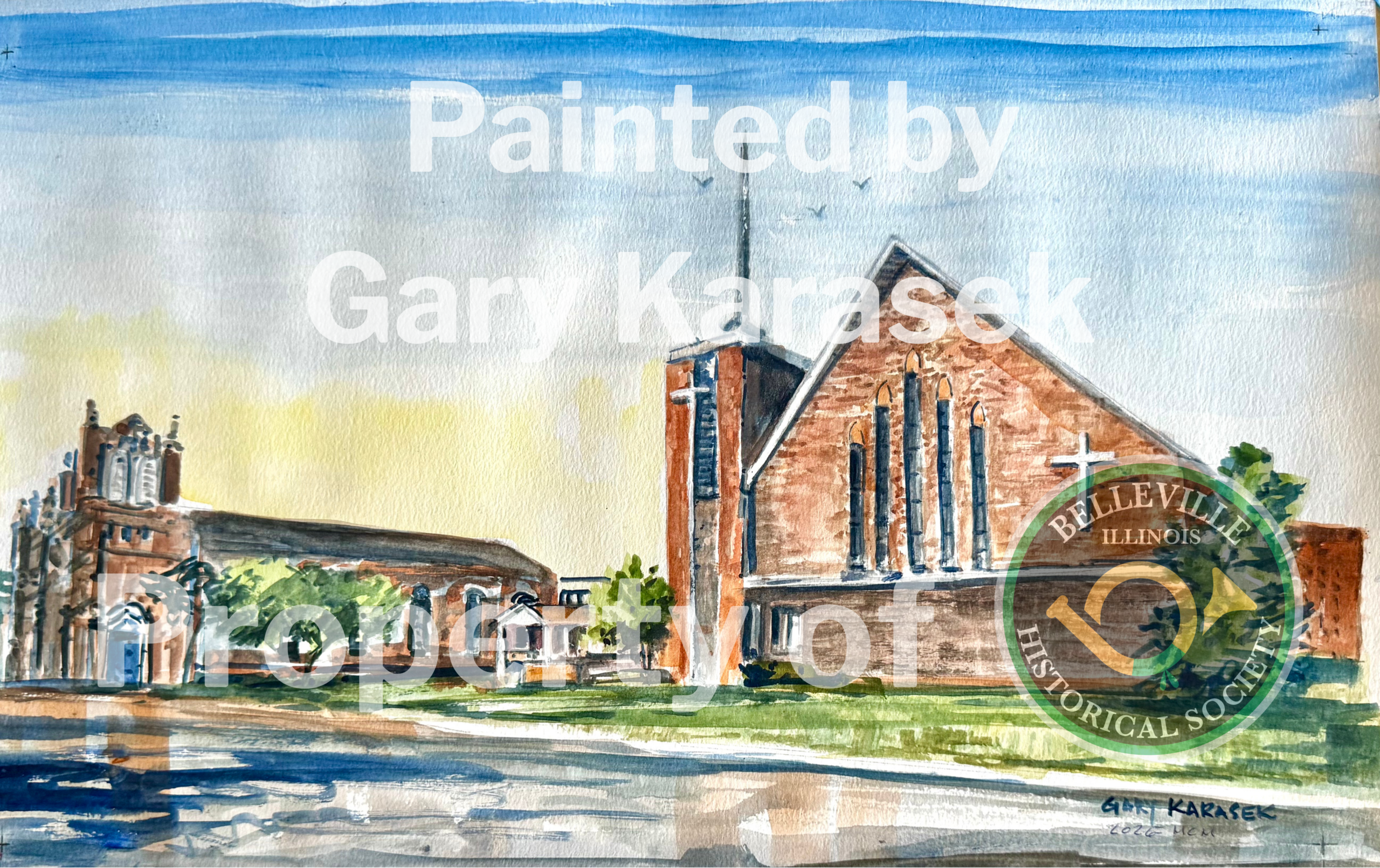
St. Paul United Church of Christ
115 West B Street
Painted by Gary Karasek
The post-World War II expansion of church membership led St. Paul United Church of Christ to plan the construction of a new sanctuary to replace the sanctuary constructed in Local architect and church member Lyman Weisenstein began planning for the new sanctuary in 1954. Groundbreaking occurred in 1956, and the first service in the new sanctuary took place in 1959. The modern style architecture of the brick and stone-faced building avoided ornamentation. Belleville Sheet Metal Works fabricated the 35-foot tall stainless steel steeple. Emil Frei Company of St. Louis produced the hand-blown stained glass of the windows. Ferd Ganschinietz Company of Belleville had the construction contract. In 2003, additions to the sanctuary included a new entrance and welcome center under a new steeple.
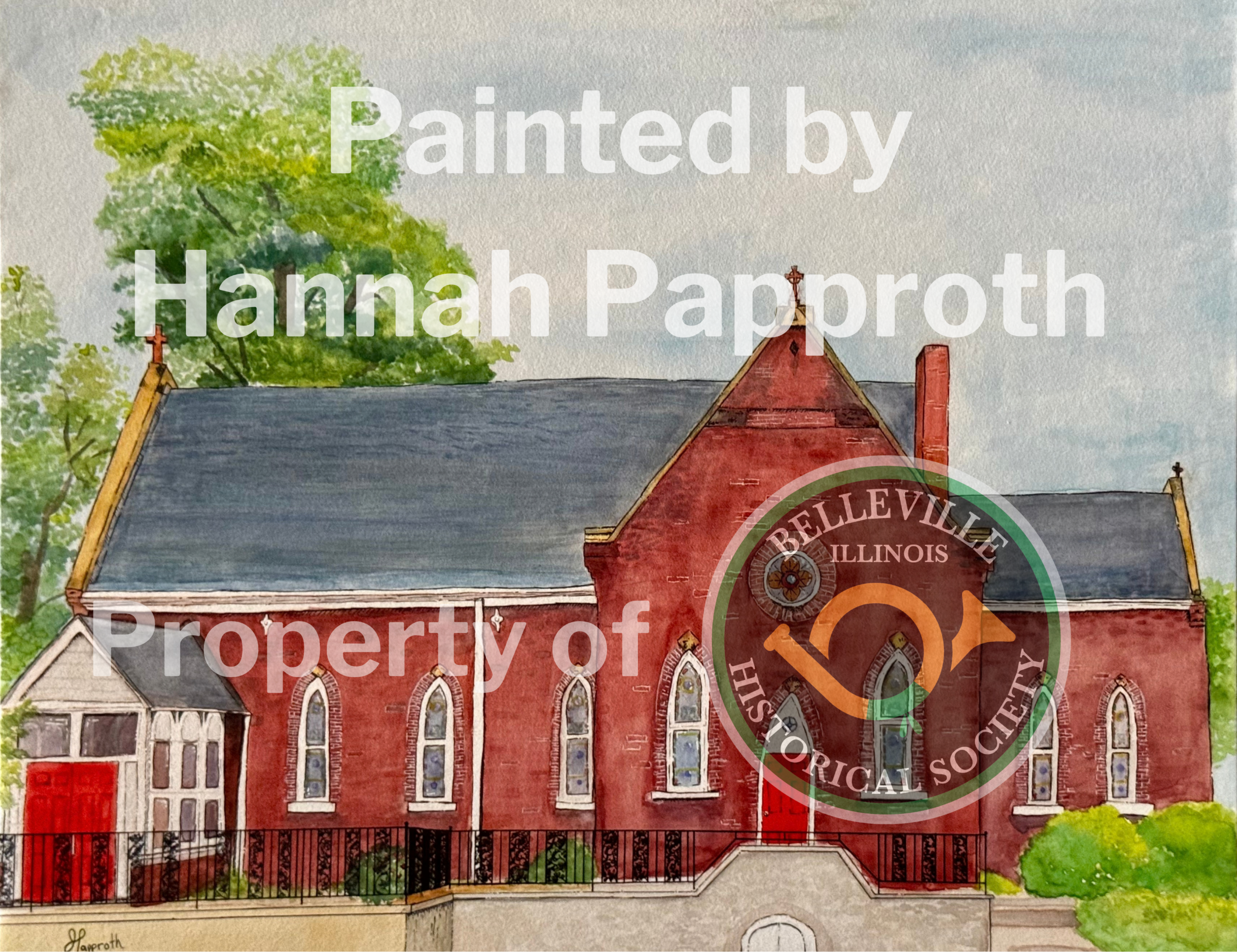
St. George’s Episcopal Church
105 East D Street
Painted by Hannah Papproth
An Episcopalian congregation had worshiped in Belleville in the 1860s but disbanded. Renewed interest in the denomination in 1880 led to the establishment of a mission church, which met in different locations. Completion of St. George’s Episcopal Church in 1883 provided a permanent home for Belleville Episcopalians. The building, a Gothic structure, has rolled stained glass windows manufactured in St. Louis. In 1991, the Episcopalians built a larger church adjacent to the original building that maintained the Gothic style. The new sanctuary also housed St. Mark Lutheran Church (Evangelical Lutheran Church of America), which the Episcopalians had hosted since 1981.
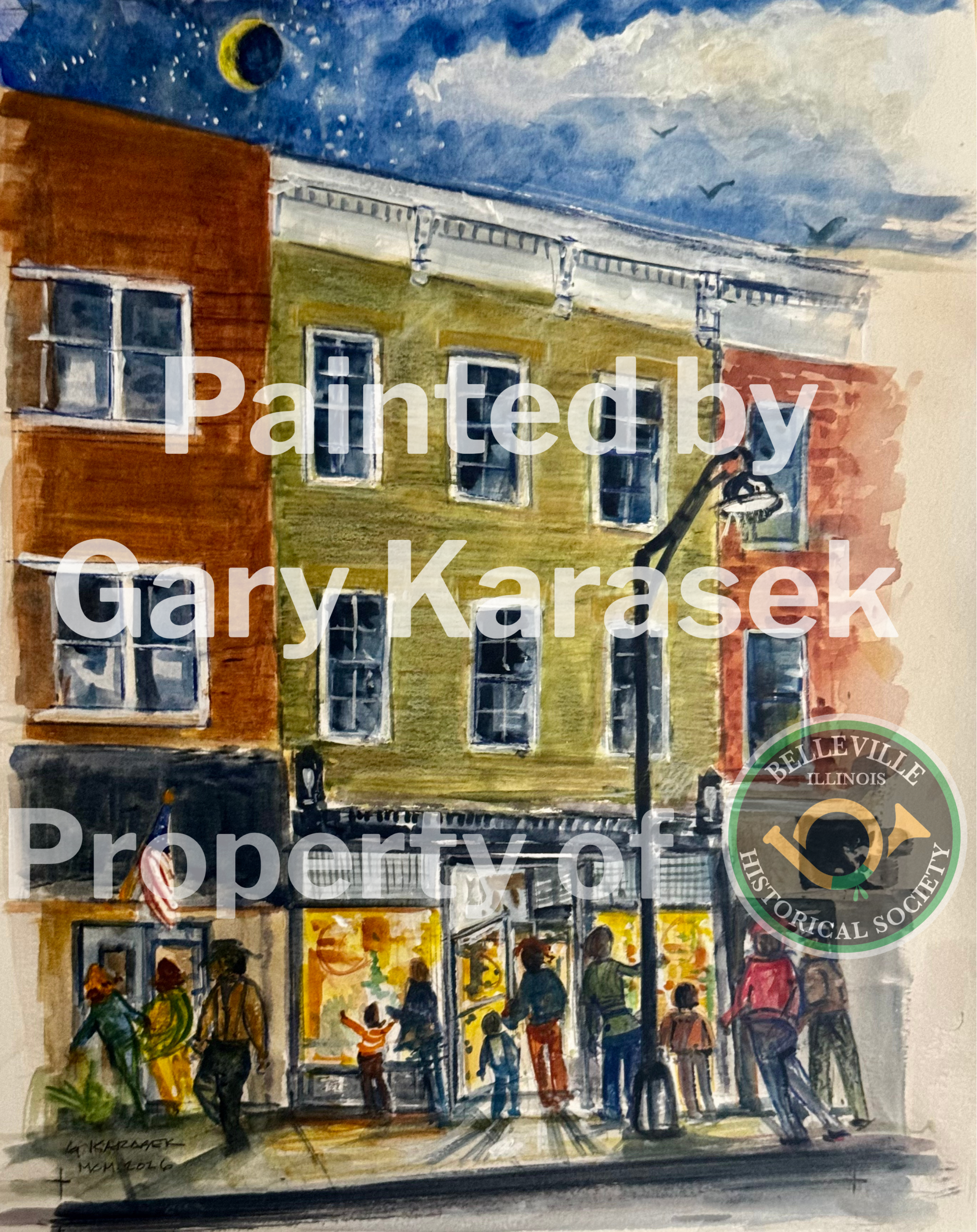
Local Lucy’s
122 East Main Street
Painted by Gary Karasek
An apprentice shoemaker from Hesse Darmstadt, Germany, William Huff immigrated to Belleville in 1836 and had this building constructed in 1852. His shoe store was on the main floor, while he lived above with his family and rented the rest of the upper floors to Illinois House, George Glanig’s adjacent hotel. The Huff family sold the property in 1906. A major successor was Bridges and Ward Pharmacy, which took over the building in 1925. The pharmacy installed an ornamental cast-iron front and conducted business here for 46 years until Krummrich Pharmacy moved into the building. It closed in 1998, ending the building’s 73-year use as a pharmacy. In 1998, Allison’s Common Scents Shoppe moved into the building and was joined by Dave’s Home Brewing Supplies. They were succeeded in 2012 by Christian Powell’s Happy Hop Homebrew and Gourmet. In 2019, Down the Hall Homebrew moved into the space and was joined by Shoehorn Brewing in 2020. Christy Vineyard and Nancy Schulte’s Local Lucy’s gift shop has conducted business here since 2023.
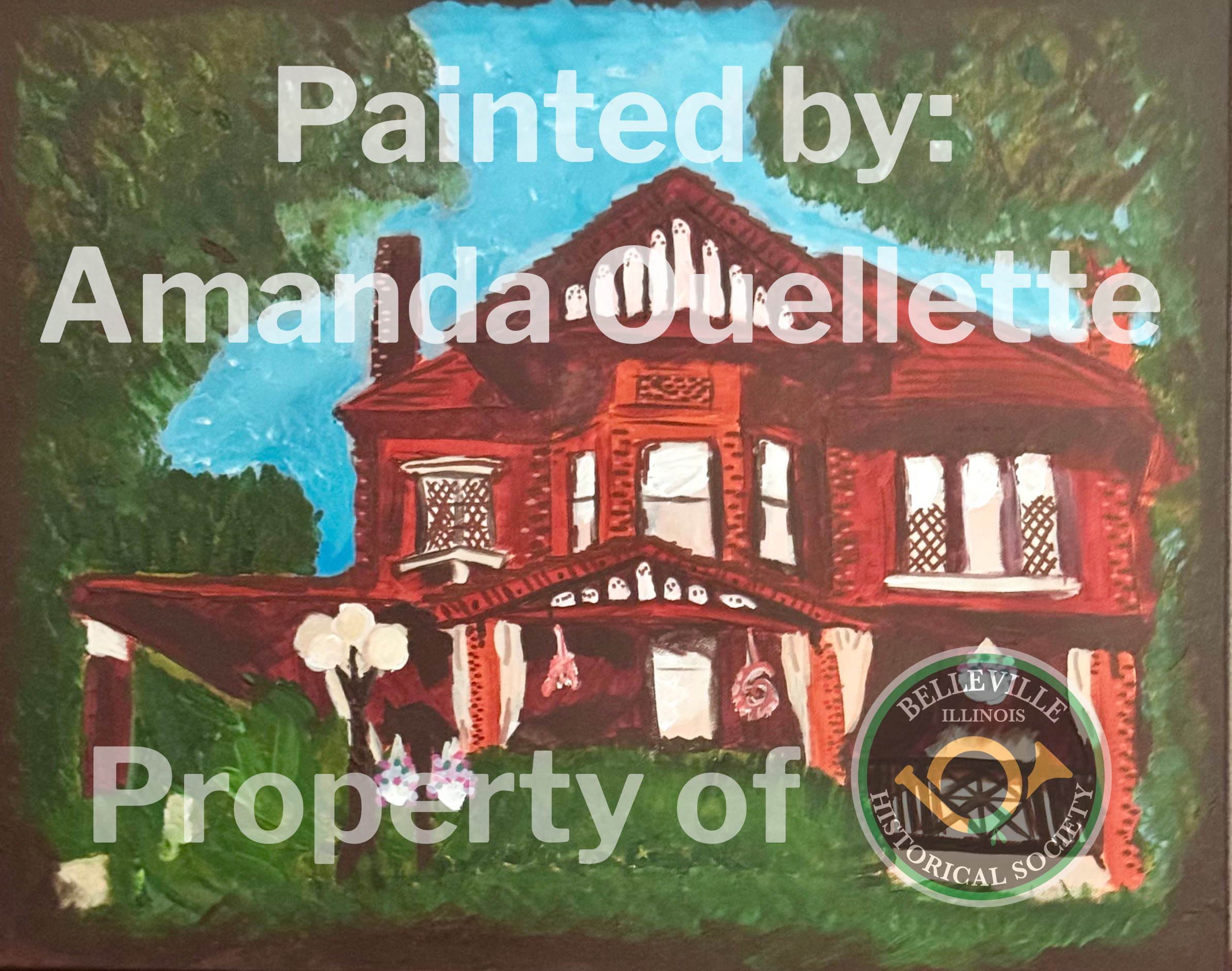
Joseph and Margaret Leopold Residence
112 North Pennsylvania Avenue
Painted by Amanda Ouellette
Joseph Leopold was a liquor dealer and senior partner of Joseph Leopold & Brother, which imported more than 80 brands of wines and liquors as well as traded in domestic brands. In 1906, Leopold contracted with architects Riester and Rubach to design an English Country style home that was constructed later in the year. The Leopold family sold this home to Joseph Cipfel in 1977. He would become the president of Belleville Area College. Successor owners included actor Jim Knoebeloch and his wife, television producer Beth Sullivan. He was best known for his role as the enigmatic barber on Dr. Quinn Medicine Woman.
Charles and Anna Kaysing Residence
220 South Virginia Avenue
Painted by Mike Killian
This house is a hundred years old this year. Charles Kaysing had this brick residence with its terra cotta details constructed in 1926. Otto Rubach was probably the architect. Kaysing was a pharmacist on Main Street for over 40 years. The Kaysings sold the house to Adolph V. Streck in 1937. He was a partner in the Streck Brothers meat packing plant. The Streck family owned the house for 60 years, selling it in 1997.
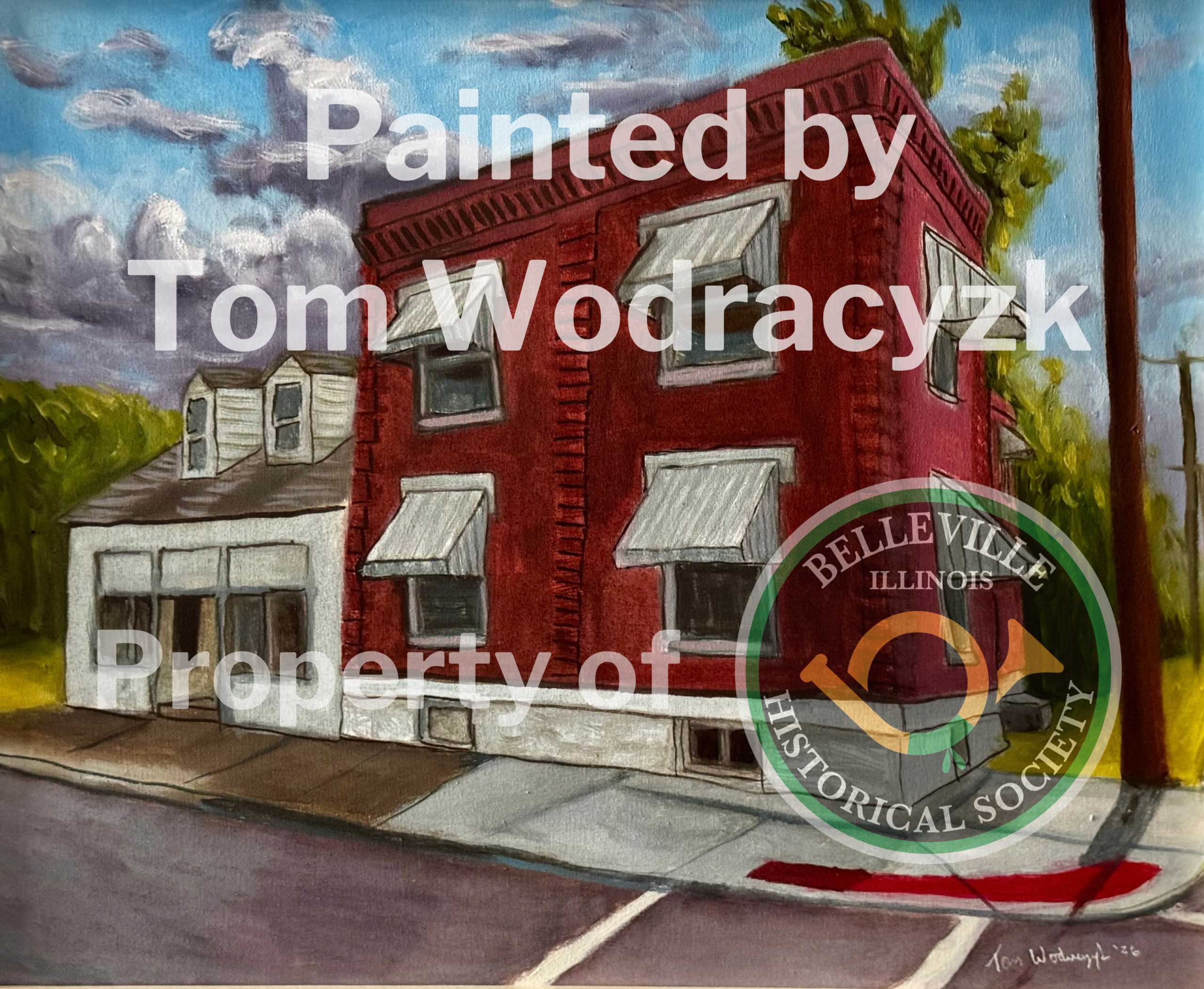
Julius and Anna Heinemann Butcher Shop and Residence
100-102 North 11th Street
Painted by Tom Wodarczyk
The Heinemann property consists of two linked buildings. The oldest dates to about 1875. Its appearance as a German American Folk House belies its history. It served as train station for the St. Louis Railroad and Coal Company (the Pittsburg Line). It was simultaneously a saloon. Julius Heinemann moved into the property and converted it into a butcher shop and residence in the 1890s. His refusal to adopt the “up-to-date method of embalming beef” increased his clientele so that he could build a four-square residence adjoining the butcher shop in 1901. He was a member of various school boards for 22 years, including the Belleville Township High School Board. He was a Belleville Turnverein trustee. The two Heinemann children became prominent. Gustav Heinemann became a Turner instructor. He was a pioneer in the Olympics gymnastics movement, coaching the US women’s gymnastics team in the 1936 Berlin Olympics, the first Olympics in which women gymnasts competed, and in the 1948 Olympics. He was inducted as member of the first class of the US Gymnastics Hall of Fame. Selma Heinemann Kissel gained a reputation as a ballet dancer and led a 63-year career as a dance instructor. After prolonged negotiation with the city, the Belleville Historical Society acquired the building to save it from demolition. The society stabilized the building and sold it to a buyer who saw the structure’s potential but was unable to realize it. The building again faces demolition.

Skyview Drive-In
5700 North Belt West
Painted by Susan Rogers
In 1923, the family-owned Bloomer Amusement Company came into Belleville to operate movie theaters. The theaters were located downtown, but the company expanded into the suburbs, building the Skyview Drive-In. Opening night was July 8, 1949. Our Merry Way was the feature film. Admission was 60 cents. The rocket ship marquee dates to 1950. The drive-in has survived a tornado, devastating windstorms, and changing public taste for amusement, but the Skyview remains the last operating drive-in theater in the greater St. Louis area. It has won its share of readers-choice awards for being one of the best drive-ins in the United States.
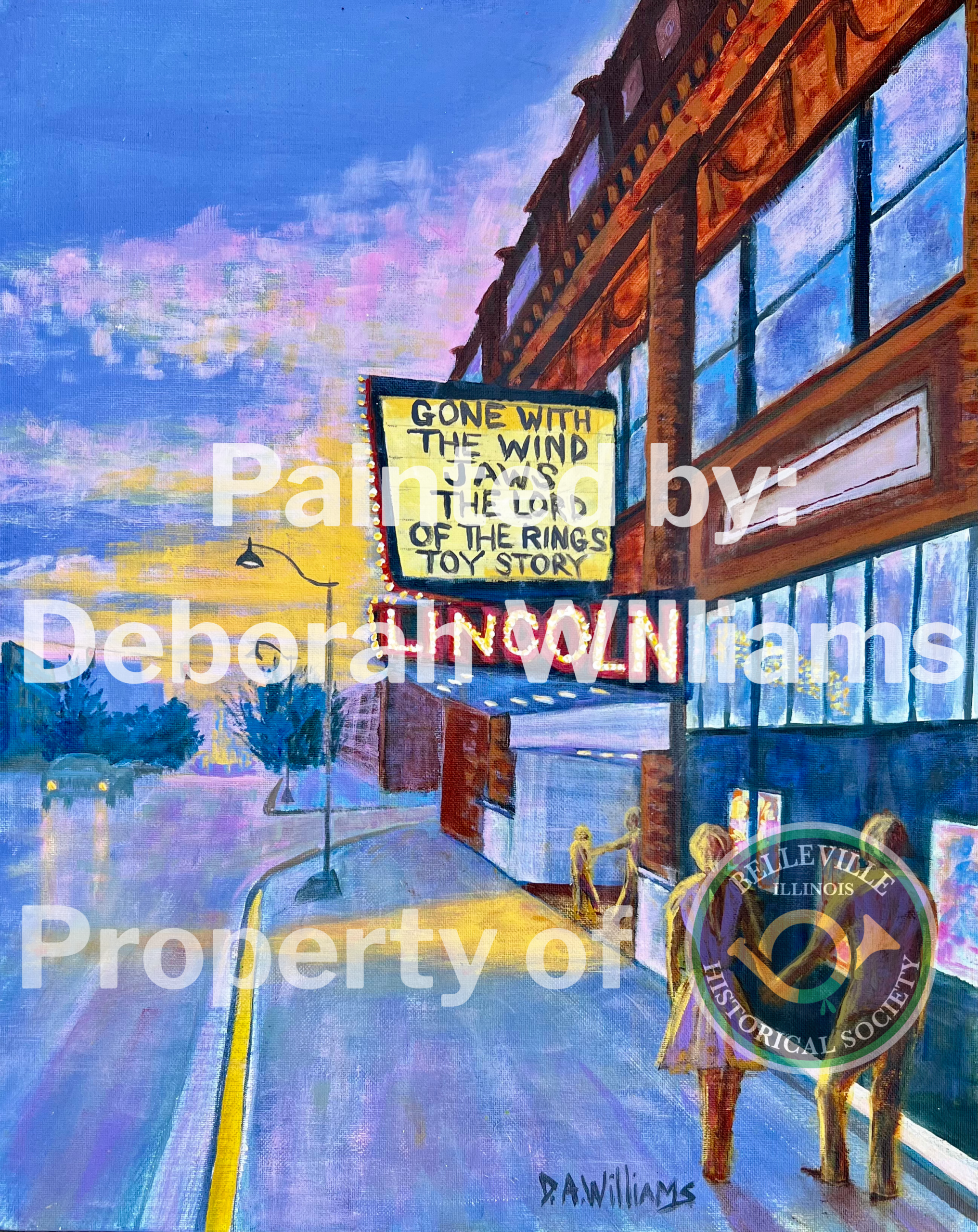
Lincoln Theatre
102 East Main Street
Painted by Deborah Williams
Opening night at the Lincoln Theatre was October 6, 1921. Built on the site of the Mansion House, a hotel that once entertained Charles Dickens, the theatre originally showed silent movies and hosted vaudevillian acts. Live music accompanied performances, at first from an orchestra pit and then from an organ that replaced the music ensembles. Silent movies were replaced by talkies in 1929. Richard Wright restored the theatre during 1980-2000 and installed a rebuilt theater organ in 1996. His daughter and son-in-law, Sandy and Dave Schoenborn, are the current owners.
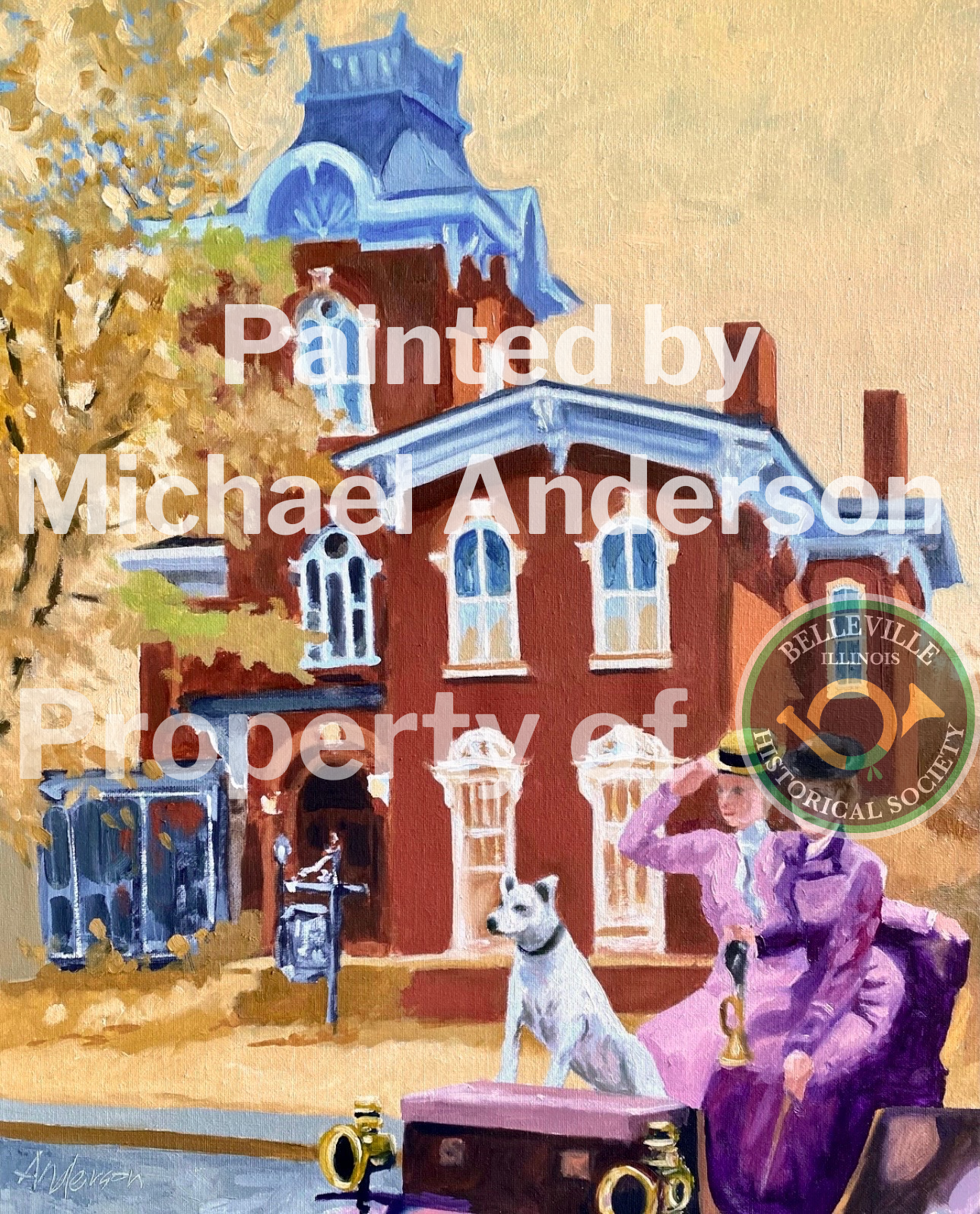
Moses W. and Melissa Carter Residence
310 East Washington Street
Painted by Michael Anderson
“Surgeon dentist” Moses W. Carter became Belleville’s first resident dentist in 1852. In 1856, he married Melissa Stookey in the home of her parents, Samuel and Mary Stookey. That building is now Papa Vito’s. The Carters lived with the Stookeys until their house was constructed next door with Stookey financial assistance. The oldest part of the residence from the 1850s is at the back of the building. The Italianate-style front with its three-story tower probably dates to the 1870s. The Carters resided here until 1910. Buyers for the residence could not be found until 1919, when Arthur Eidman bought the building to reflect his growing prominence as a founder and officer of the new St. Clair National Bank. Arthur and Artis Eidman sold their home to John W. and Pearl Johnson in 1941. A real estate agent, Johnson rented out sleeping rooms in the residence. Johnson family ownership ended in 1963. Attorney Paul Storment acquired the building in 1974 and preserved its historic character. After his law office moved, the Storment family sold the building in 2020. Since 2021 the historic building has hosted Grafted, an elegant wine bar.
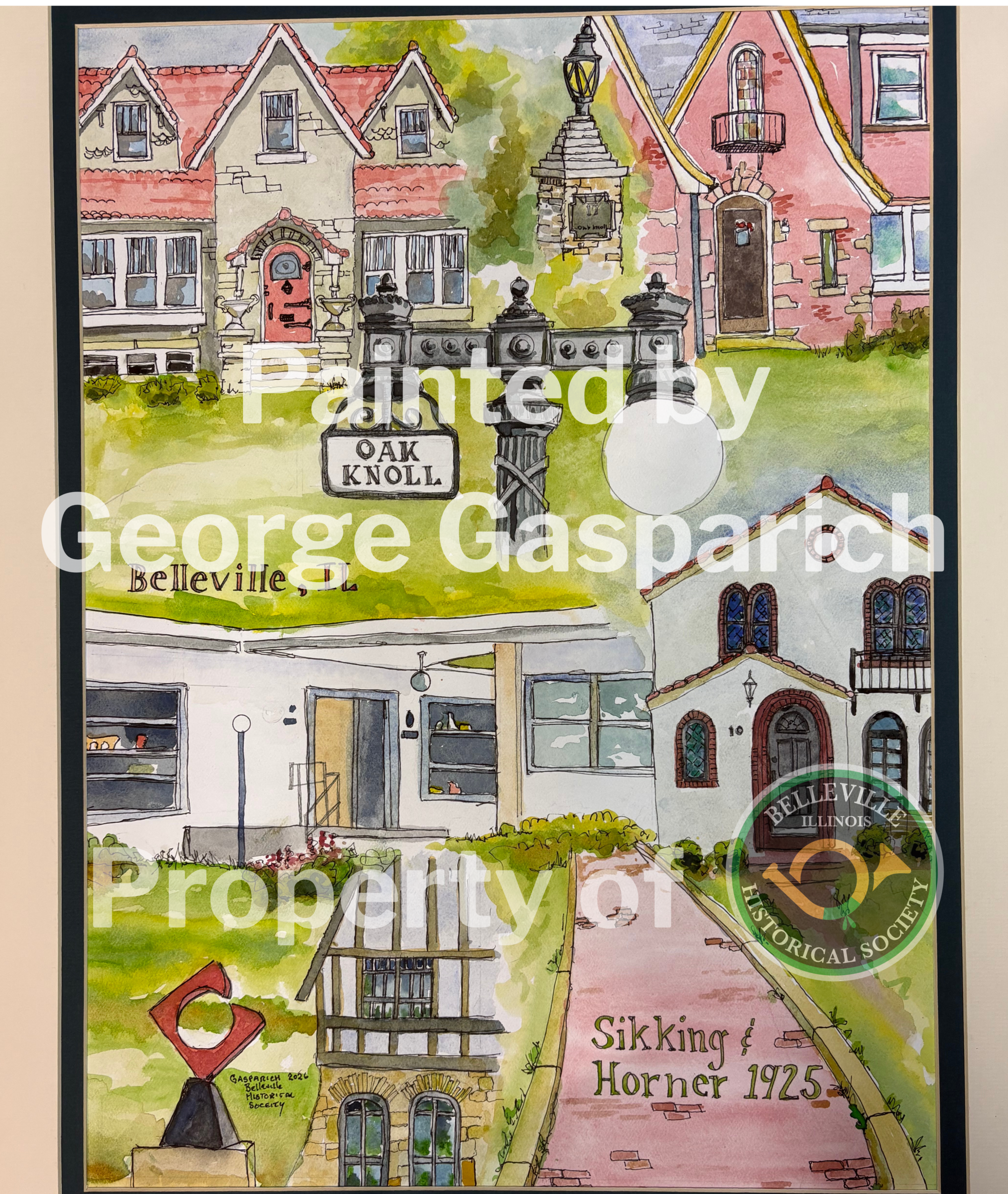
Oak Knoll
Oak Knoll Place
Painted by George Gasparich
The Oak Knoll subdivision opened for development in 1925, promising city workers that they would enjoy the suburban experience with “their full share of the sun rays.” Woodlands surrounded Oak Knoll building lots. The developers sought to attract the businesspeople of Belleville, East St. Louis, and St. Louis. Building covenants, large lots, curving streets, and cul-de-sacs fostered a sense of quiet comfort and economic security. Architectural styles of the homes ranged from Tudor to Colonial Revival to Mid-Century Modern.
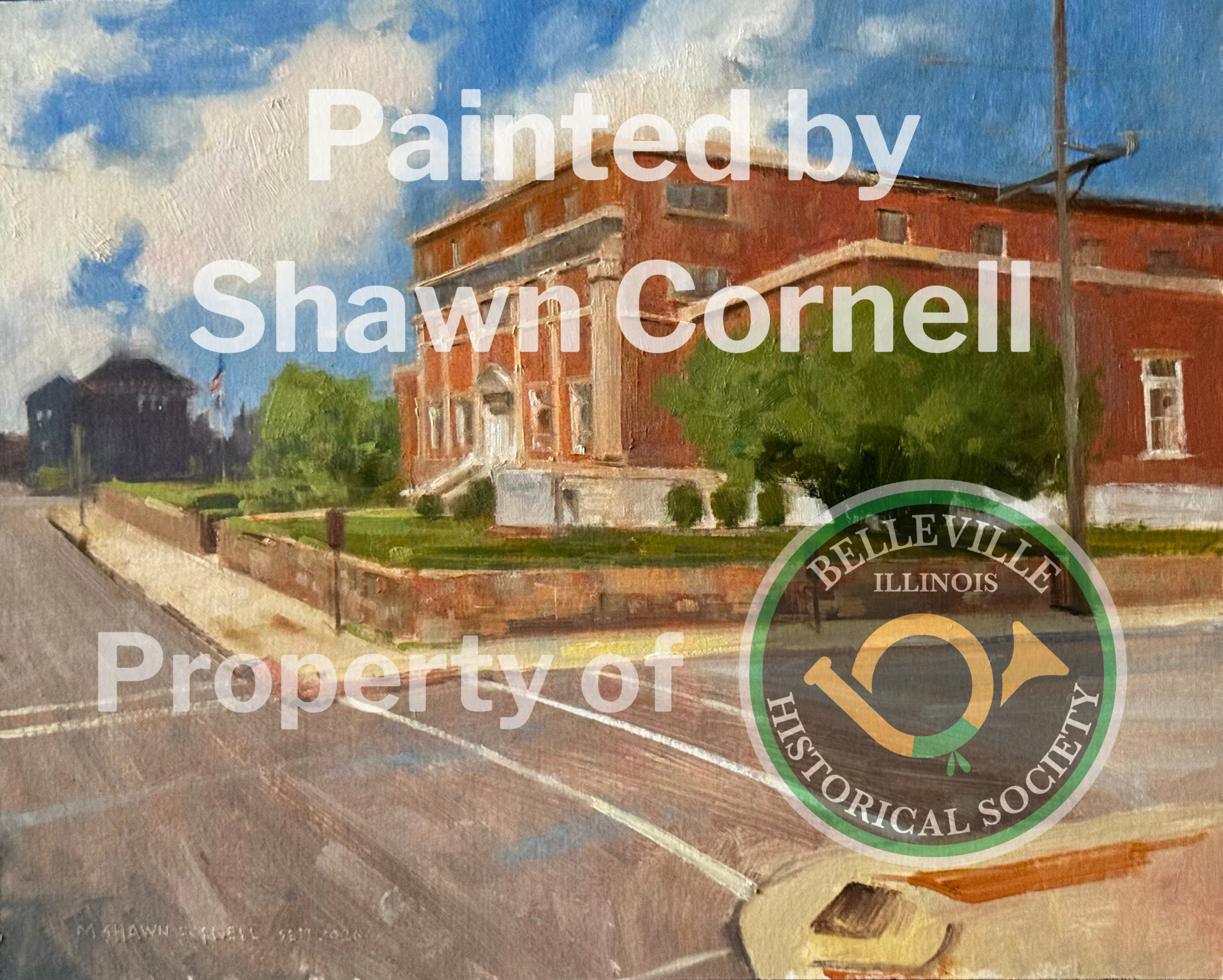
Masonic Temple
225 East A Street
Painted by Shawn Cornell
The Masons form the oldest secular fraternal order in Belleville. They have had a continuous presence since 1842, with St. Clair Lodge No. 24 being the oldest organization. Desiring to having a permanent home in the 1920s, the Masons hired the renowned architect William B. Ittner to design the Masonic Temple. They thought big. The temple was to house eight Masonic organizations. The first-floor hall seated a thousand and had a stage and dressing rooms. The main lodge room on the second floor held 400. Amenities included an electric player organ. The temple was dedicated in 1926. The Masons have found an innovative means to upgrade the building and maintain ownership. They have leased the first floor to Sugarfire Events of St. Louis for a banquet center, “the Ballroom at Belleville.”
Dietz Memorial Hall
316 North 2nd Street
Painted by: Isabel Dethrow
Nothing is forever, but Joseph and Mary Dietz, did the best they could to ensure that veterans of the American Civil War in Belleville who had found to save the federal union would have a permanent meeting place. In 1909, they donated “forever” their old home to Hecker Post No. 443, Grand Army of the Republic (GAR); to Hecker Woman’s Relief Corps No. 207; and to the Memorial Day Association. Named Dietz Memorial Hall, the building also would host other veterans’ organizations that developed in the city.
A native of Germany, Joseph Dietz became a prosperous grocer in Belleville following his service in the Civil War. He built his brick Italianate style home in 1888, which became Dietz Memorial Hall. Hecker Post No. 443, the Belleville affiliate of the GAR, appeared first on the deed conferring ownership of Dietz Memorial Hall. The GAR was a lobbing and fraternal organization advocating for union veterans’ issues, such as pensions. It promoted veteran comradery. It led Memorial Day observances to honor deceased war veterans. Memorial Day parades to Walnut Hill Cemetery began at Dietz Hall. The second beneficiary was the Woman’s Relief Corps, the auxiliary of the GAR. The local Hecker post was organized in 1892 to support the GAR by perpetuating the memory of the heroes of the Civil War, assisting their widows and orphans, and helping destitute veterans.
The auxiliary in 1906 erected the monument in Walnut Hill Cemetery honoring veterans of the Civil War that became the focal point of Memorial Day observances. It acquired burial plots for destitute Civil War veterans. The woman’s auxiliary sought to promote patriotism through lectures and events. It was in charge of Dietz Memorial Hall. The Memorial Day Association was the third grantee of Joseph and Mary Dietz. It had been established through Hecker GAR guidance to perpetuate Memorial Day observances. The Belleville post of Spanish American War veterans met at the hall. In 1919, Hilgard Post 58 of the American Legion organized at Dietz Hall and met there for some years. The Hecker Post GAR came to an end in 1943, but the Woman’s Relief Corp continued to use the building into the 1950s. St. Clair County acquired the building through the sale for delinquent taxes in 1969 and negotiated the sale of the property. The new owner converted the memorial hall into an apartment building.
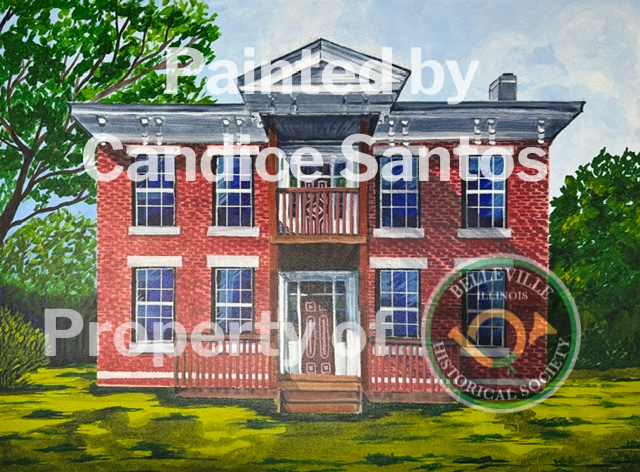
William and Nancy McClintock Residence
1007 Forest Avenue
Painted by Candice Santos
As early as the 1840s, the McClintocks built their Greek Revival style mansion overlooking the road to Mascoutah. A Kentuckian by birth, William McClintock came to St. Clair County in 1818. He moved to Belleville and began a lucrative career as a shopkeeper, but he also farmed. By the time of his death in 1886, he had amassed 700 acres of farmland. He was a founder and first president of Belleville’s first volunteer fire department. He was a justice of the peace and St. Clair County clerk. Sarah’s family, the Eymans, had lived in the county since the 1790s. McClintock’s heirs subdivided and sold the property in 1918.
Chelar Tool and Die
11 Florida Avenue
Painted by Brenna Roche
In 1933, immigrant German die makers George Dresel and Frank Betz established Dresel-
Betz Company to manufacture dies that stamped out parts. The largest die the company
produced weighed 13 tons and was used to stamp out the cab of a Caterpillar tractor. The
company moved to its new factory on Florida Avenue in 1936. Dresel and Betz retired
from manufacturing in 1962, but three of their employees, Elmer Katt, Charles Flynt, and
Art Engel, bought the manufacturing business and incorporated it as Chelar Tool and Die
in 1962. The name Chelar comes from the first two letters of the first name of the
founders. Chelar produces stamping dies, metal stampings, and specialty precision
machining for the appliance, electrical, heating, ventilation, and air conditioning industries.
Chelar can machine parts 300 inches in length weighing 20 tons. It continues to grow and
now occupies a 60,000 square-foot facility.
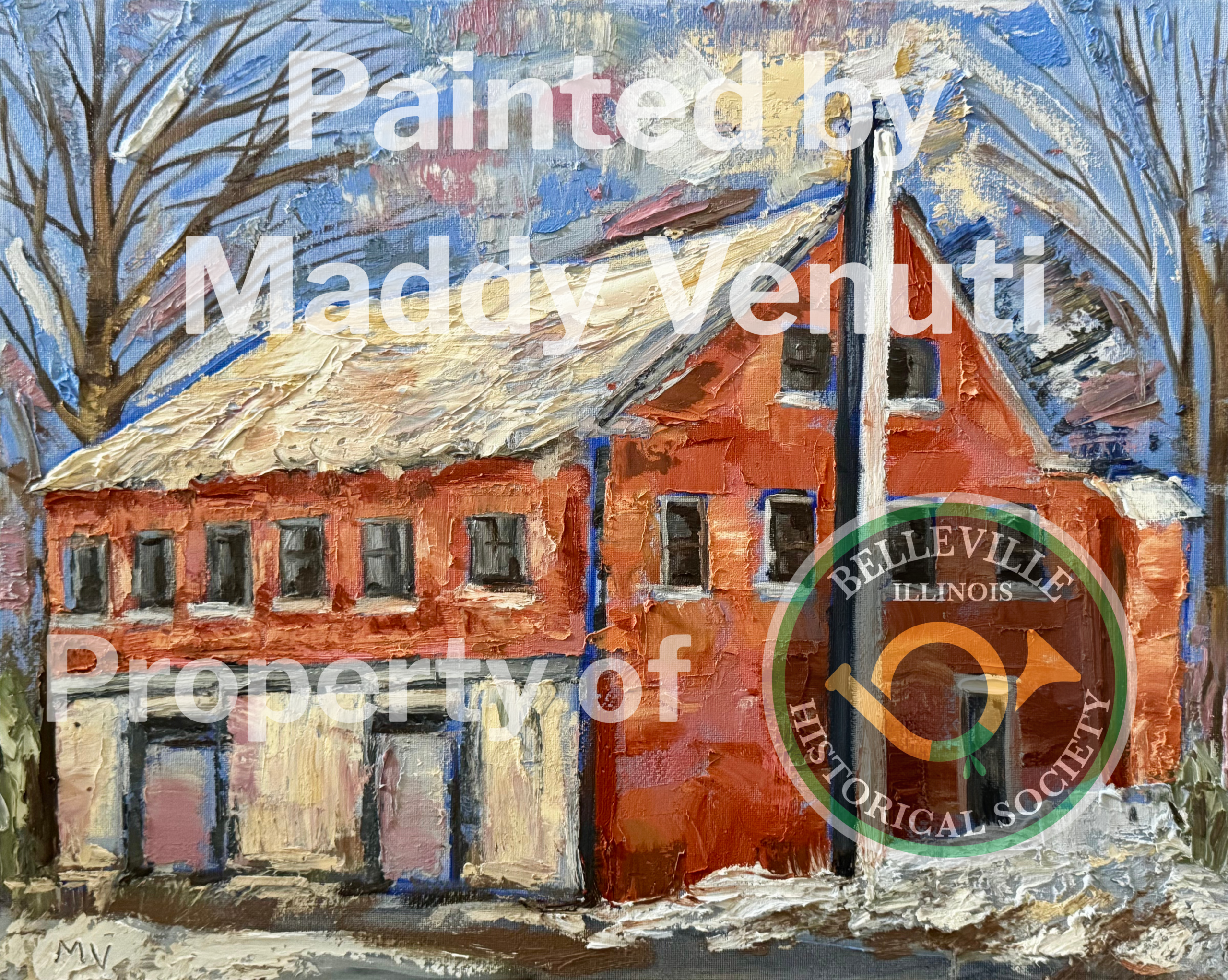
Ernst Weisenborn’s Grocery and Dry Goods Store
1112 West Main
Painted by Maddy Venuti
Ernst Weisenborn constructed this building at the time of the American Civil War. He was an emigrant from Thuringia in Germany, who became a mover and shaker in the independent town of West Belleville. For over 30 years he operated a grocery store and dry goods store on the main floor, while he lived on the second floor and rented out rooms. During this time he was an officer in town government and owned a coal mine and a quarry. Weisenborn’s successors used the building for a variety of businesses including a hotel, saloons, restaurants, and a discount shoe store. In more recent times the building has housed attorneys and other professionals on the first floor, while apartments were rented out on the second floor. In 2025, the Harp Pub began business on the main floor.
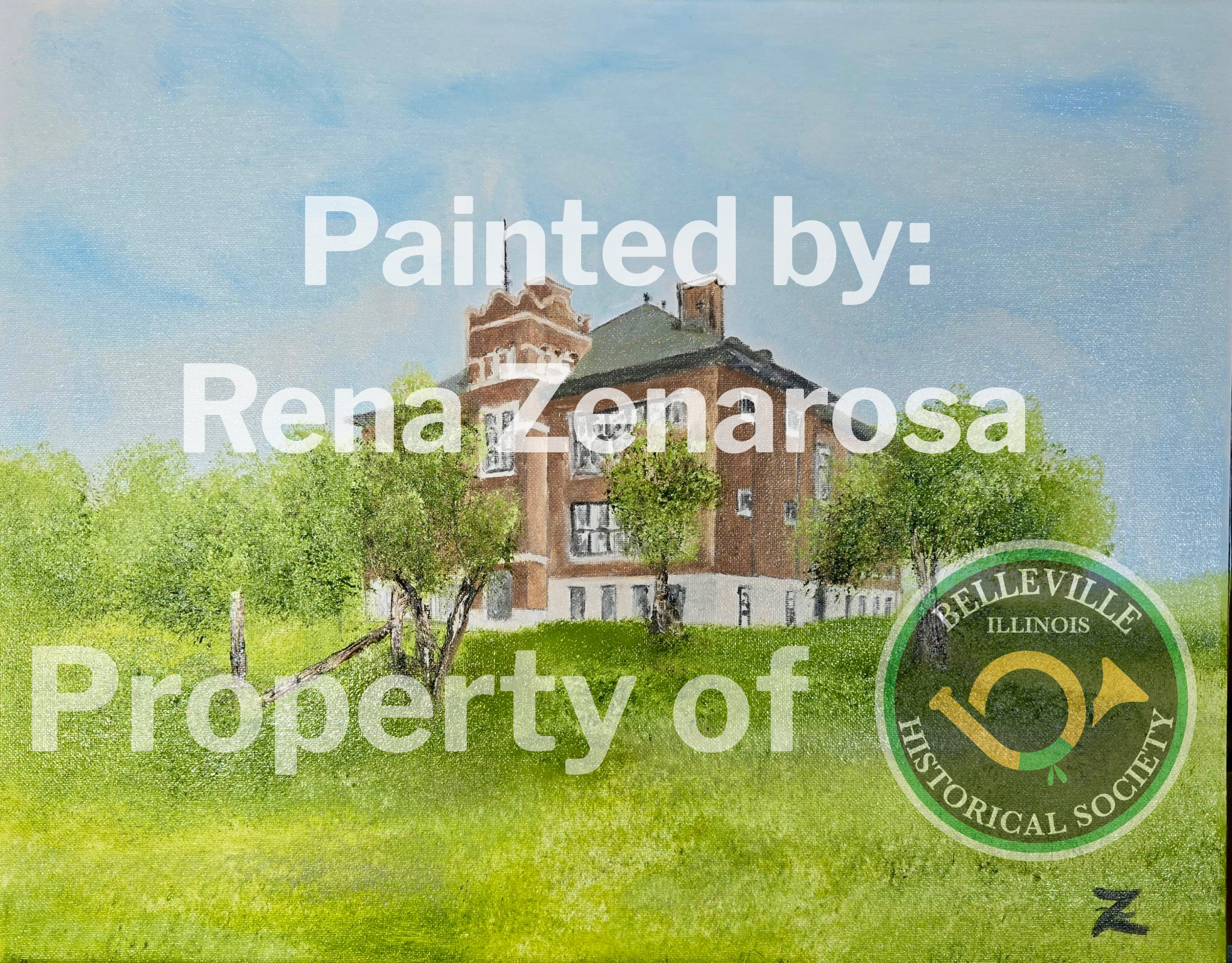
Henry Raab School
1120 Union Avenue
Painted by Rena Zenarosa
When Henry Raab School opened in 1907, the news reporter enthused that it “surpassed in practically every point school buildings of the larger cities—but then there’s nothing too good for Belleville.” The building was befitting its namesake Henry Raab, the beloved educator who taught in Belleville schools for nearly 30 years and served as city school superintendent. He was twice elected state superintendent of public schools. The $35,000 building was modern in every way. It had eight classrooms—one for each grade. Each classroom had a cloakroom. Classroom windows were so large that their glass surface equaled one-sixth of the room’s floor space. They were installed on one side of the room so that desks could be arranged in such a way that sunlight beamed directly over the student’s left shoulder. Small windows were on the other side of the room. In the basement were playrooms and sanitary closets, where fixtures with automatic flushing devices emptied into a septic tank. Despite its modern conveniences the building was not fireproof. Fire gutted the building in 1960. The school board proposed demolishing the school and enlarging existing schools to house Raab students, but public opposition prevailed. The new Henry Raab School opened in 1962.
You must be logged in to post a comment.