In honor of Belleville’s Bicentennial, the Belleville Historical Society was able to realize one of our earliest visions for our organization and the city: The Belleville Walk of Fame.
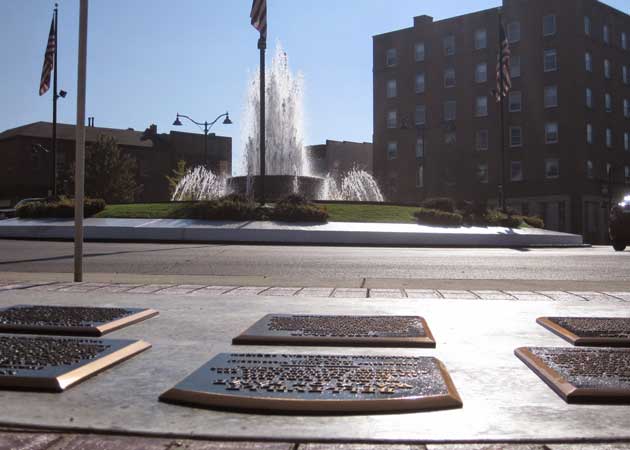
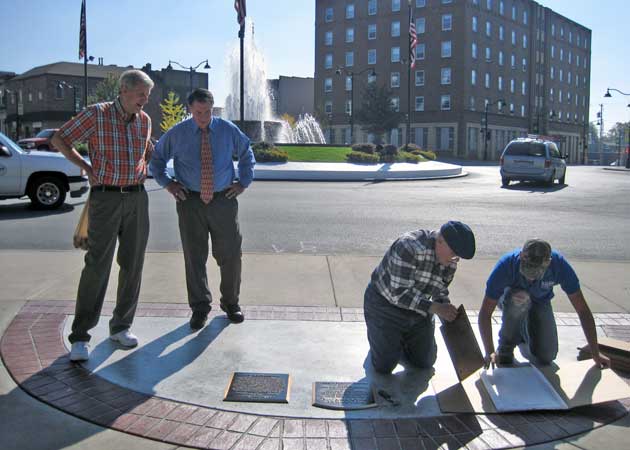
With help from the city of Belleville and concrete donated by Upchurch Concrete, the Walk was installed on the northwest quadrant of the Public Square, celebrating five initial initial inductees at a public ceremony in October 2014.
The Walk of Fame honors people who have made significant contributions to the history or renown of the city of Belleville. New inductees are selected by the Belleville Historical Society Board of Trustees and Advisors and approved by the Belleville City Council. Selected honorees meet the established criteria of “having made significant contributions to our city, region, or nation or who have brought fame to Belleville.”
A new class of honorees will be inducted every two years. A separate project to install plaques on historically significant buildings in downtown Belleville also commenced in 2014.
One goal for both projects is to make Belleville’s history visible to those who live here and visit. “All of this history happened right beneath our feet, and in and around these places we pass each day,” noted historical society president Larry Betz. “We want to make that history apparent and accessible. We’re doing this to serve Belleville’s current and future residents, just as much as to honor those in its past.”
Belleville Walk of Fame
Located on the Belleville Public Square, northwest quadrant
Open in Google Maps »
2024 Inductees
Otto W. Rubach (1874-1959), Home-Grown Architect
A Belleville architect for over 40 years, Rubach shaped the cityscape of his hometown. He. sometimes in collaboration with partners, designed buildings in a variety of architectural styles. Civic buildings included the Belleville Carnegie Library, additions to the St. Clair County Courthouse, Engine House Number 3 on West Main, and the 1911 Belleville Post Office. Most every public school constructed in Belleville during the 1910s through the 1930s, including the original campus of Belleville Township High School, bore Rubach’s name. Commercial buildings on Main Street included the Commercial Building, Belleville Savings Bank, and St. Clair National Bank. His numerous residences included homes for Peter Fellner, Herman Wangelin, and Jay Haines. Rubach was also a member of the Belleville Library Board of Directors.
Thomas J. Gundlach (1892-1981), Industrialist
orn on a farm near Belleville, Gundlach in 1923 establish the T. J. Gundlach Machine Company, a general machine shop and welding firm first known for automobile engine repair. By the 1940s the company was exporting machinery worldwide. In 1948 Gundlach invented a rock crusher that could reduce coal chunks to uniform size suitable for use in new automatic coal feeders (mechanical stokers). Generations of rock crushers since have been based on this technology that made Gundlach a leading name internationally. Gundlach established the JMJ Products Company to manufacture floor and wall tile cutters in 1946. The business became the first in the nation to hold an election to select a union bargaining agent under the Taft Hartley Act of 1947.
2022 inductees
George Bunsen (1794-1872), Public Education Advocate
Born in Frankfurt am Main, Germany, Bunsen fled to St. Clair County in 1834 after participating in a failed revolt. He farmed with other Latin Farmers and taught school. He was elected a delegate to the Illinois Constitutional Convention of 1847. Bunsen was county school superintendent from 1855 to 1959. After moving to Belleville in 1857 he established a primary school model to demonstrate best teaching practices and was elected a city school director in 1859. He advocated for the St. Clair County Teachers’ Institute, which improved teaching techniques. In 1857 he was a charter member of the board of directors of the State Board of Education tasked with organizing a teacher-training college, Illinois State Normal University, later Illinois State University.
Audrey Marsh King (1920-2010), Global Entrepreneur
A native of Belleville, King entered the family business, Marsh Stencil Company, in 1952 and became the manager of export sales. By 1998 she had developed a network of distributors in a hundred countries. She was a member of overseas trade missions and was the first female member of the St. Louis Regional Commerce and Growth Association’s board of directors. The US Department of Commerce appointed her to advisory commissions and presented her company with two “E” awards for increasing US exports. In 2004 King was inducted into the national Packaging and Processing Hall of Fame. She served on the board of directors of Memorial Hospital and was a board member and president of the Belleville Philharmonic.
2020 inductees
Ruth Sterling (1905-1994), Pioneer Business Executive
Belleville native Sterling graduated from Belleville Township High School in 1922 and worked as a stenographer. By 1925 she was an assistant secretary at the Belleville Casket Company and rose through the ranks to become company president in 1953, serving until 1972. In 1968 she was elected treasurer of the Casket Manufacturers Association of America. During her early years at the company Sterling played center on the Turner girls’ basketball team. She was a founder of the Belleville chapter of the St. Clair County League of Women Voters in 1943 and a frequent officeholder. A member of the Belleville School District 118 Board of Education during 1947-1953, she became the chairman of the finance committee.
Theodor Erasmus Hilgard (1790-1873), Democracy Jurist and West Belleville Developer
For Germans yearning to live in a freer land, Justice Theodor Hilgard of the appellate court of Rhenish Bavaria encouraged scouts to immigrate to the United States to locate favorable places to settle. In 1833 they began the Latin Farmer migration, bringing to St. Clair County university-trained professionals with a knowledge of Latin who desired to farm. Hilgard followed them here in 1836, buying 134 acres adjoining Belleville to farm. He subdivided this land and sold it to develop the village of West Belleville. He donated land for a public school that later was incorporated into the Belleville school system. Before he returned permanently to Germany in 1854, Hilgard published both political studies and poetry.
2018 inductees
Carrie Thomas Alexander-Bahrenburg (1861-1929), Progressive Activist
Daughter of prominent civic leader Colonel John Thomas, Alexander-Bahrenburg in 1887 took over management of Belleville Citizen’s Horse Railway. In 1900 she was elected one of the first female trustees of the University of Illinois. She became in 1915 the national president of the Woman’s Relief Corps, the auxiliary of the Grand Army of the Republic that advocated for Union veterans of the Civil War and promoted patriotism. Devotion to woman’s suffrage led her to organize the Belleville Civic League and to hold leadership positions in the Illinois Equal Suffrage Association and the National American Woman Suffrage Association. She tirelessly urged city government to impose and enforce Prohibition laws.
Les Mueller (1919-2012), Citizen Pitcher
A Belleville native, Mueller pitched in the minor leagues after graduating from Belleville Township High School in 1937. The Detroit Tigers called him up for the 1941 season. Following service in World War II he returned to Detroit in 1945 and was a member of the World Series Championship team and set a record by pitching 19 2/3 continuous innings that year. He returned to the family furniture business in Belleville in 1949 after three years in the minors but was a player, manager, and sponsor in county and Mon-Clair leagues. A city alderman during 1957-1961, he was also a founder of the voluntary association that established Citizens Park in 1958.
2016 inductees
Gustavus P. Koerner (1809-1896) & Sophia Engelmann Koerner (1815-1888), German-American Reformers
Abandoning hope of political reform in Germany, members of the Friedrich Engelmann family, including daughter Sophie, immigrated to the Belleville area in 1833. Sophie’s suitor, Gustave Koerner, accompanied them after participating in a failed revolt. He served as a state supreme court justice and lieutenant governor, becoming the first German American to be elected to a statewide office in Illinois. His hostility to slavery led him to the new Republican Party and to garner German-American support for the party. He was a manager for Abraham Lincoln at the 1860 Republican Convention and was minister to Spain during the Civil War. Sophie was a founder of the Belleville Kindergarten Association in 1874. Gus Koerner, who immigrated to Illinois from Germany to Illinois in 1833, was elected Illinois Lieutenant Governor in 1852. He played a primary role in the organization of the Republican Party in Illinois and served as manager for Abraham Lincoln at the 1860 Republican Convention. Sophia, Gustave’s wife, was founder of the Belleville Kindergarten Association in 1874. Their home on Mascoutah Avenue is currently under restoration.
Edward Daley (1887-1930), Preemintent Town Booster
A Missouri newspaperman, Daley came to Belleville in 1916 to become the executive director of the new Greater Belleville Board of Trade and promote the civic and economic development of Belleville. In 1917, he led the effort to convince the War Department to construct Scott Field nearby and lobbied thereafter to prevent the airfield from closing. Daley became the first executive director of the Belleville Chamber of Commerce in 1924 and orchestrated the planning and financing of the Hotel Belleville during 1929-1930. Recognizing the role of the automobile in economic development, he became the manager of the St. Clair Auto Club in the 1920s to promote highway use.
Julius Liese (1843-1920), Entrepreneur-Musician
A native of Bavaria, Germany, Liese arrived in Belleville in 1864; became a bookkeeper; and began teaching music. He joined the new Belleville Philharmonic orchestra in 1867 and became its second conductor in 1869. Until his resignation in 1885, Liese’s leadership strengthened the infant organization. He refused to accept compensation for his work. He was also the director of the Saengerbund German singing society as well as a charter member of its successor, the Liederkranz. In 1874, he established Liese Lumber Company, and he served as a board member of Belleville factories. He was a company officer and by 1900 the president of Sucker State Drill Company, for which he was co-inventor of a seed-planting drill.
2014 inductees

Belleville Mayor Mark Eckert and inductee Bob Goalby spoke at the Walk of Fame’s inaugural induction ceremony. Belleville Historical Society vice president David Cox was the emcee.
George Blair (1759-1833), Belleville’s Founder
Blair was a Scottish American who arrived in St. Clair County in the 1790s and became the county sheriff. Soon after 1800 he moved to a 200-acre farm in the Clinton Hill Precinct. On March 10, 1814 he concluded negotiations with a county commission to make his farm the county seat to comply with the territorial government’s requirement that the county seat be centrally located. In return for moving county government from Cahokia to his land, Blair donated one acre to the county for the public square, platted a town he named Belleville (French for “beautiful city”), and promised to donate every fifth lot to the county.
Ninian Edwards (1775-1833), Illinois Leader, Town Developer
Edwards came to Illinois from Kentucky in 1809 to become territorial governor. After Illinois attained statehood in 1818, he served as one of the state’s first two US Senators. Even before moving to Belleville in 1824, Edwards heavily invested in the town. In 1817 he purchased all of Belleville’s unsold lots and encouraged development by giving or selling them at discounted prices to people such as teachers and skilled artisans he believed would benefit the town. In 1826 he was elected the state’s third governor. During the Belleville cholera epidemic of 1833, he contracted the disease while aiding cholera victims and died.
Lyman Trumbull (1813-1896), Apprentice Politician to National Leader
A native of Connecticut, Trumbull arrived in Belleville in 1837 to practice law. He successfully challenged the last legal justification for slavery in Illinois. Before moving from town in 1848, he entered politics, serving a term in the Illinois House and twice becoming Secretary of State. Subsequently he would serve on the Illinois Supreme Court before becoming a US Senator, defeating, among others, Abraham Lincoln. He was a founder of the Illinois Republican Party. When in the US Senate he was a major force behind the adoption of the 13th Amendment to the Constitution, which abolished slavery in the United States.

Christian “Buddy” Ebsen (1908-2003), Star of Stage, Screen, and Television
Born in Belleville, Buddy was the son of Christian Ebsen, the physical fitness instructor of the Belleville Turners. Fitness and dance instruction by his father served Buddy well and led to a 70-year career in show business. The Ebsen family left Belleville in 1920, and by the late 20s Buddy was performing on Broadway as a dancer. He arrived in Hollywood in the 1930s and danced in films starring Shirley Temple and Judy Garland. He gained recognition in television in the 1950s in Walt Disney’s “Davy Crockett,” but greater fame came in the 1960s and 70s when he starred in the “Beverly Hillbillies” and “Barnaby Jones.”
Robert “Bob” Goalby (1929), Masterful Athlete
A Belleville native, Goalby graduated from Township High School in 1947 after starring in football, basketball, and baseball. He played football at the University of Illinois but chose golf for his career. Having honed his golf skills while a caddie at the St. Clair Country Club, Goalby turned professional in 1952 and eventually won 11 PGA tournaments. In 1963 he was chosen to play on the US Ryder Cup Team and in 1968 won the Masters Tournament Championship. He was instrumental in forming the Senior PGA Tour (now the Champions Tour) in 1979 and went on to win two senior tournaments. Throughout his career, Goalby remained a resident of Belleville, where he continued to promote civic improvement.
You must be logged in to post a comment.