A SALOONIST, BELLEVILLE’S FOUNDRY INDUSTRY, AND 123 WEST MAIN STREET
Written by: Bob Brunkow
When Heinrich Schmitt (1830-1886), a saloonkeeper and entrepreneur, decided to build an investment property near his saloon on West Main Street, he wanted a cast-iron front for the building. A local foundry satisfied his requirement. Founded in 1882, City Foundry and Machine Works fabricated the front. It was one of three cast-iron fronts known to have been erected in Belleville. (The others are at 312 East Main, also manufactured by City Foundry, and 26 East Main.) Documents show that Schmitt’s 123 West Main Street property was standing in 1884.
The cast-iron front indicates that the building could have been constructed only as early as 1882. The building is Italianate in style, with overhanging eaves having decorative brackets beneath. Schmitt followed the same style of the building that he had constructed in 1878 at 119 West Main for his saloon and residence. The two buildings are almost twins, except that 123 has a cast-iron front, while 119 has dormers. The fronts of both buildings have had substantial alterations.
Heinrich Schmitt’s new building expanded his economic presence in Belleville. Schmitt was a native of Bavaria, who settled in Belleville in the 1850s. By 1860 he operated a saloon on the same block where he would later construct 119 and 123 West Main. He rented apartments in his saloon building. He invested in Belleville businesses, and he was a director of People’s Bank. 119 gave Schmitt the opportunity to rent apartments on the second floor and to rent the first floor to businesses.
The first known business in 119 was Eckhardt Brothers Dry Goods and Groceries, which had moved into the building by 1884. By 1887 the brothers were succeeded by Michael Kastel, a confectioner, baker, and restauranteur, who operated M. Kastel’s Restaurant and Oyster House here in the 1890s. After Heinrich died, Clara, his wife, and other family members moved into 119 from the saloon building. They left 119 about 1901. A cavalcade of businesspeople have occupied the building since the Schmitts left, including furniture dealers, butchers, clothiers, and attorneys.
An architectural detail of note may date to the late 1920s, when Gately’s clothiers offered the “finest clothing and jewelry on payments.” The window above the west-end front door of 123 is a single piece of plate glass that has a grid pattern to make it look like it was made of separate panes. A ribbed roller was rolled over the back of the glass to texturize it. The resulting window was inspired by high-end businesses that used prism glass windows that
actually consisted of individual panes of glass set into frames. To judge the effectiveness of this effort to find a more economical way to mimic an expensive architectural feature, compare the window in 123 with the prism glass windows over the display windows at 201 West Main.
Though fewer in number than the buildings along Downtown Belleville’s East Main Street, West Main Street’s buildings also merit attention for their architecture and history.
The Belleville Airport: The Other Field of Dreams
Written by: Bob Brunkow
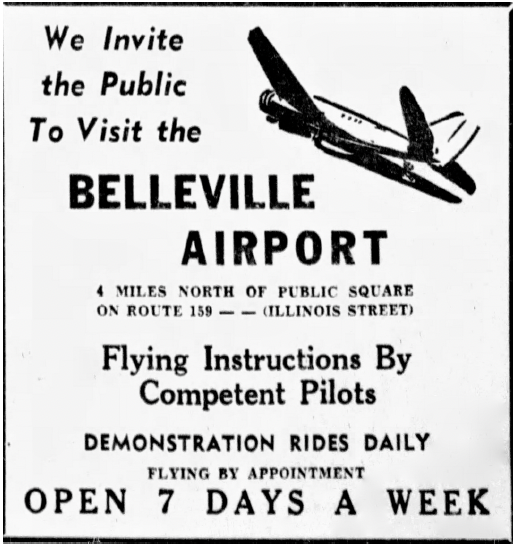
For nearly as long as Americans have been flying, Bellevilleans have been fascinated by air transportation a nd have sought to become part of the air transportation network. Belleville leaders were largely responsible in 1917 for the establishment of nearby Scott Field, with anticipation that commercial aviation might result from that military base to the economic benefit of the city. Due to advocacy 80 years later, the opening of the Mid-America St. Louis Airport at Scott in 1997 brought commercial aviation to the area.In between the opening of Scott and the completion of the joint use airport there, civic leaders dreamed about developing Belleville’s own municipal airport. By the late 1920s, city leaders observed that Belleville still needed a municipal airport. The Illinois State Aeronautics Commission lobbied city leaders in 1934 toapply for Civilian Works Administration funds to start the project, but the city government claimed to lack the money to complete the airport. In May 1944, local investors once again saw the commercial value of an airport in Belleville. Theyincorporated Belleville Airport, Inc., and bought 77 acres near today’s intersection of North Illinois Street and Frank Scott Parkway. Opening day was October 7, 1944. The airport was prepared for emergency flights and equipped to train pilots, repair aircraft, and rent planes. In 1946, Belleville Airport Inc., sold its property and disbanded, one of the partners observing that this airport was not suitable for flying because of the “proximity of utility wires.”Volume 15 Number 3August 2025THE BELLEVILLE AIRPORT: THE OTHER FIELD OF DREAMSBY BOB BRUNKOW Belleville leaders continued to consider Belleville Airport’s possibilities, but in 1952, Belleville Airport came to an end. Hugh and Katherine Edwards bought 177 acres of the airport to farm; all traces of the airport disappeared entirely in 1958 when they sold the land for a subdivision. The physical presence of Belleville Airport was gone, but the spirit behind it lingered. In 1960, the Belleville Chamber of Commerce lobbied for a special election to establish a Belleville Airport Authority with taxing authority to establish a municipal airport. The airport authority would build and operate a $500,000 airport, believing that it would bring more industry to the area. However, voters defeated the measure by a margin of 23 to 1, demonstrating the “tax angry” sentiment of the people. Once again a lofty idea was grounded by economic reality.
You must be logged in to post a comment.